ServiStar replaced two failed capacitors and repaired severely burned power wiring on an outdoor AC condenser, restoring safe cooling operation for a Los Angeles County homeowner.
What Brought Us to This Job
A homeowner in the San Gabriel Valley called us because their central air conditioning had stopped cooling. The outdoor condenser was running intermittently, and the system was short-cycling. A quick description of the symptoms pointed in one direction before we even opened the access panel: a failing run capacitor, possibly combined with a power supply problem at the contactor.
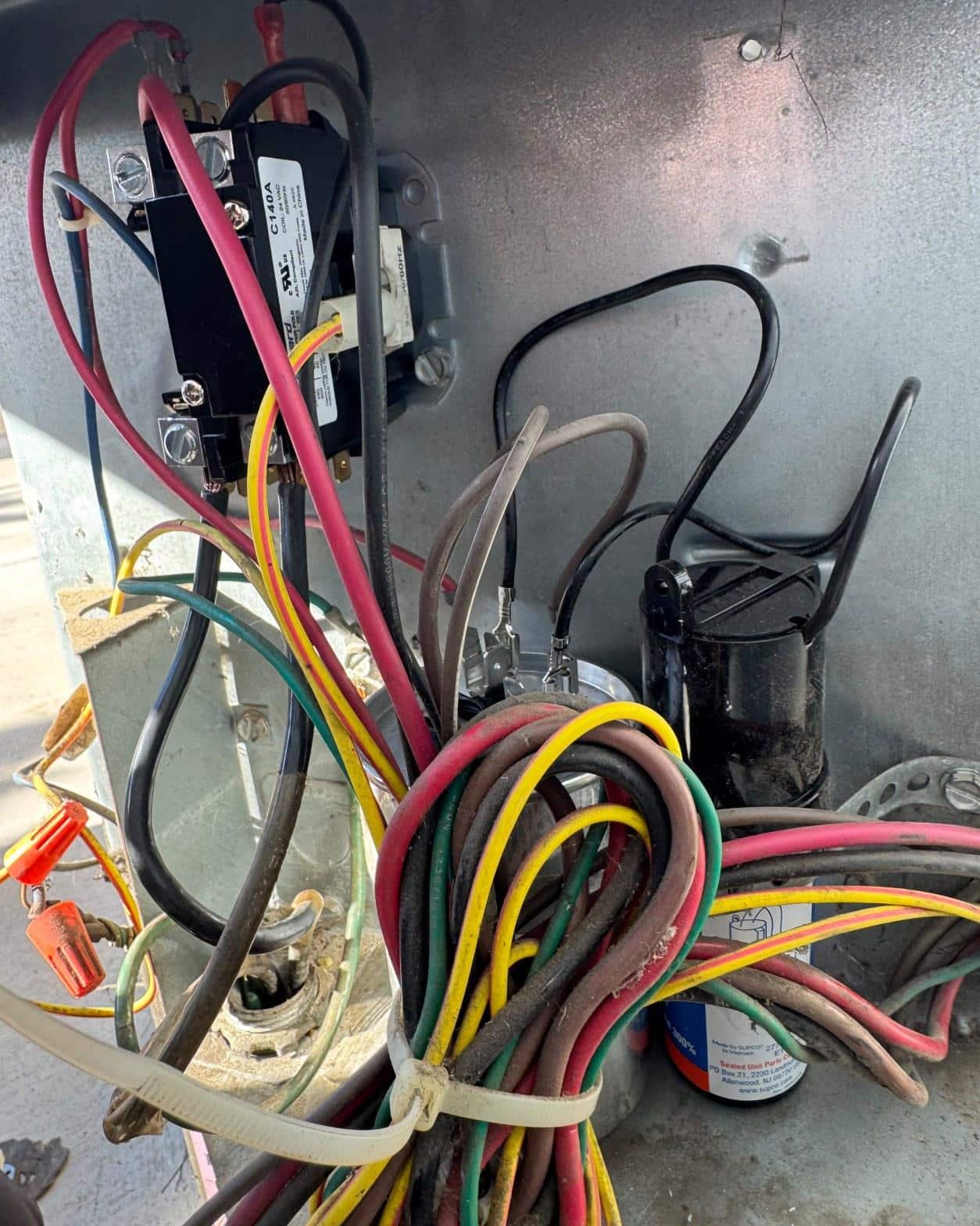
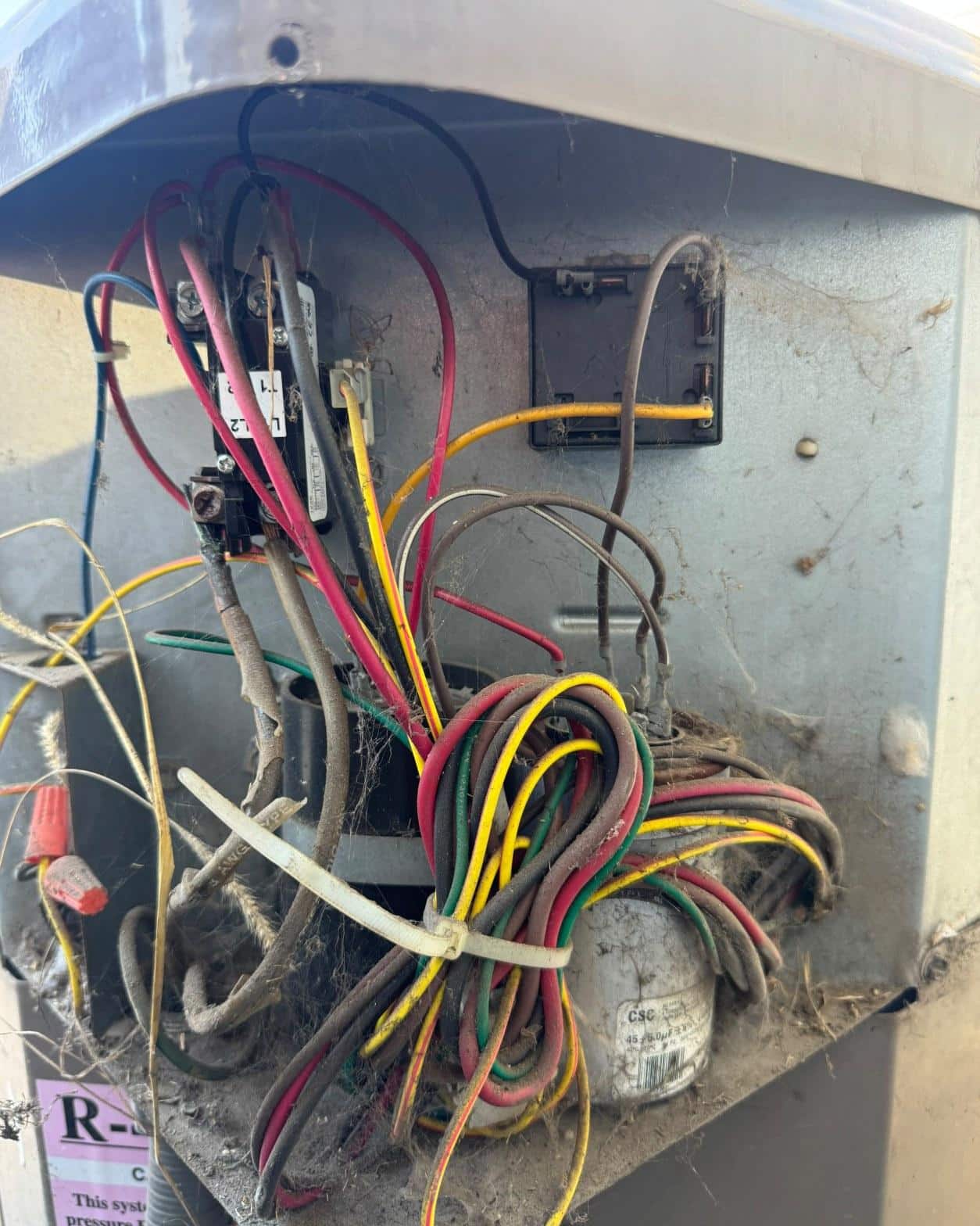
When our technician pulled the panel, three separate issues became visible immediately. The dual run capacitor on the condenser had failed, the furnace capacitor had degraded, and the 240-volt power wiring feeding the contactor showed obvious heat damage at the terminal. All three problems were contributing to the unit’s erratic behavior. We documented everything and walked the homeowner through the findings before touching a single part.
What Did We Find Inside the Condenser Panel?
The condenser’s electrical compartment contained a failed dual run capacitor, a severely burned contactor terminal, and wiring insulation that had charred down to the copper conductors. A dual run capacitor serves two motors at once: the compressor and the condenser fan motor. When it fails, neither motor receives the startup boost it needs, so the compressor either refuses to start or trips on thermal overload within seconds of trying.
The capacitor on this unit was a 45/5 MFD, 370-volt dual run type, which is among the most common configurations found on residential condensers in Southern California. Capacitors degrade gradually with heat exposure. Ambient temperatures in the San Gabriel Valley routinely exceed 95°F during summer afternoons, and the temperature inside an unshaded condenser cabinet can climb well past 120°F, which accelerates capacitor aging significantly. The EPA notes that high ambient temperatures are a primary stressor on air conditioning components, and that pattern is consistent with what technicians see across the region every summer.
Our technicians replace failed run capacitors on condensers throughout the county every cooling season, and we see the failure rate climb sharply on units that are 10 years or older. This unit showed all the signs of a capacitor that had been weakening for at least one full season before it finally gave out.
Why Is Burned Wiring at the Contactor So Serious?
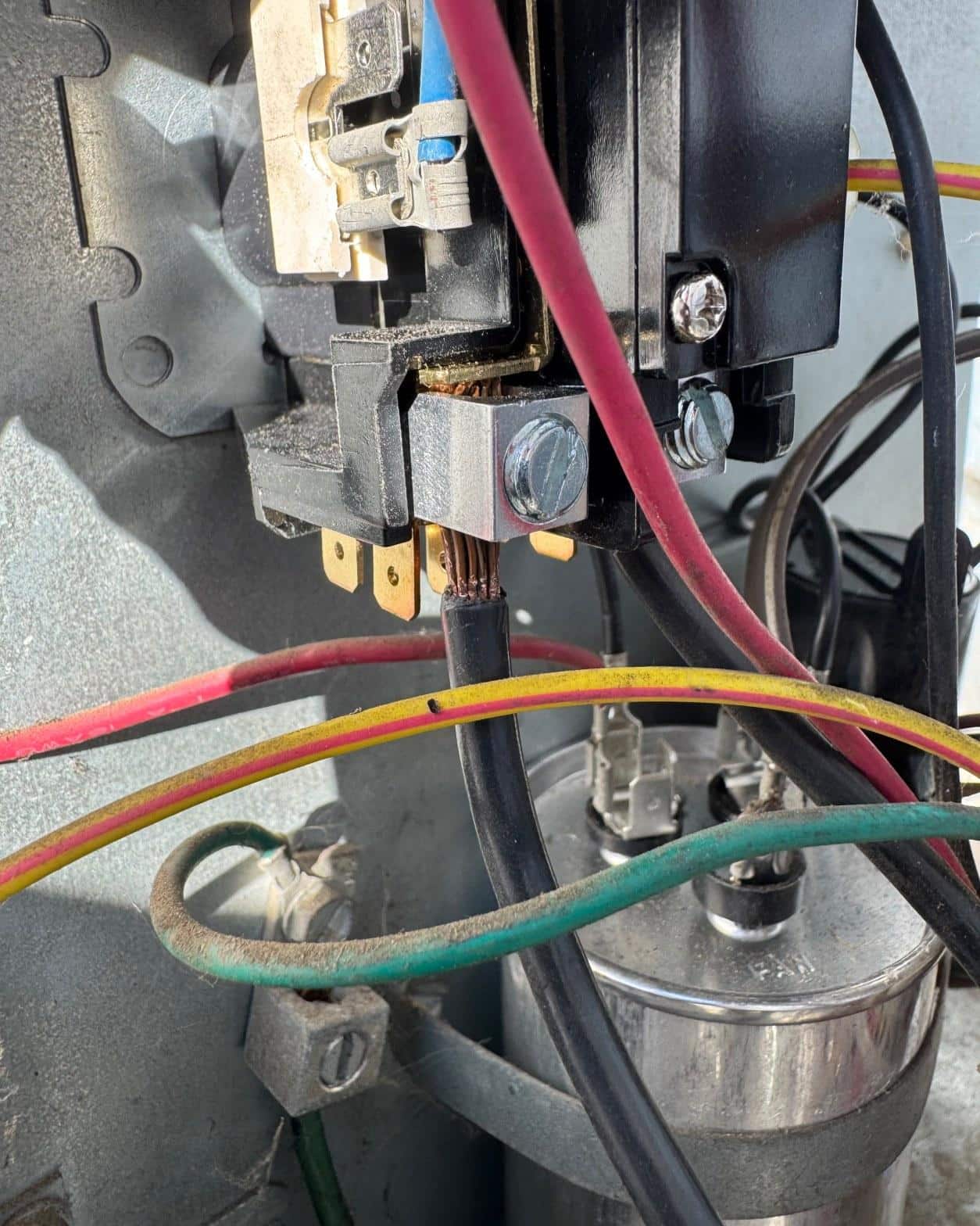
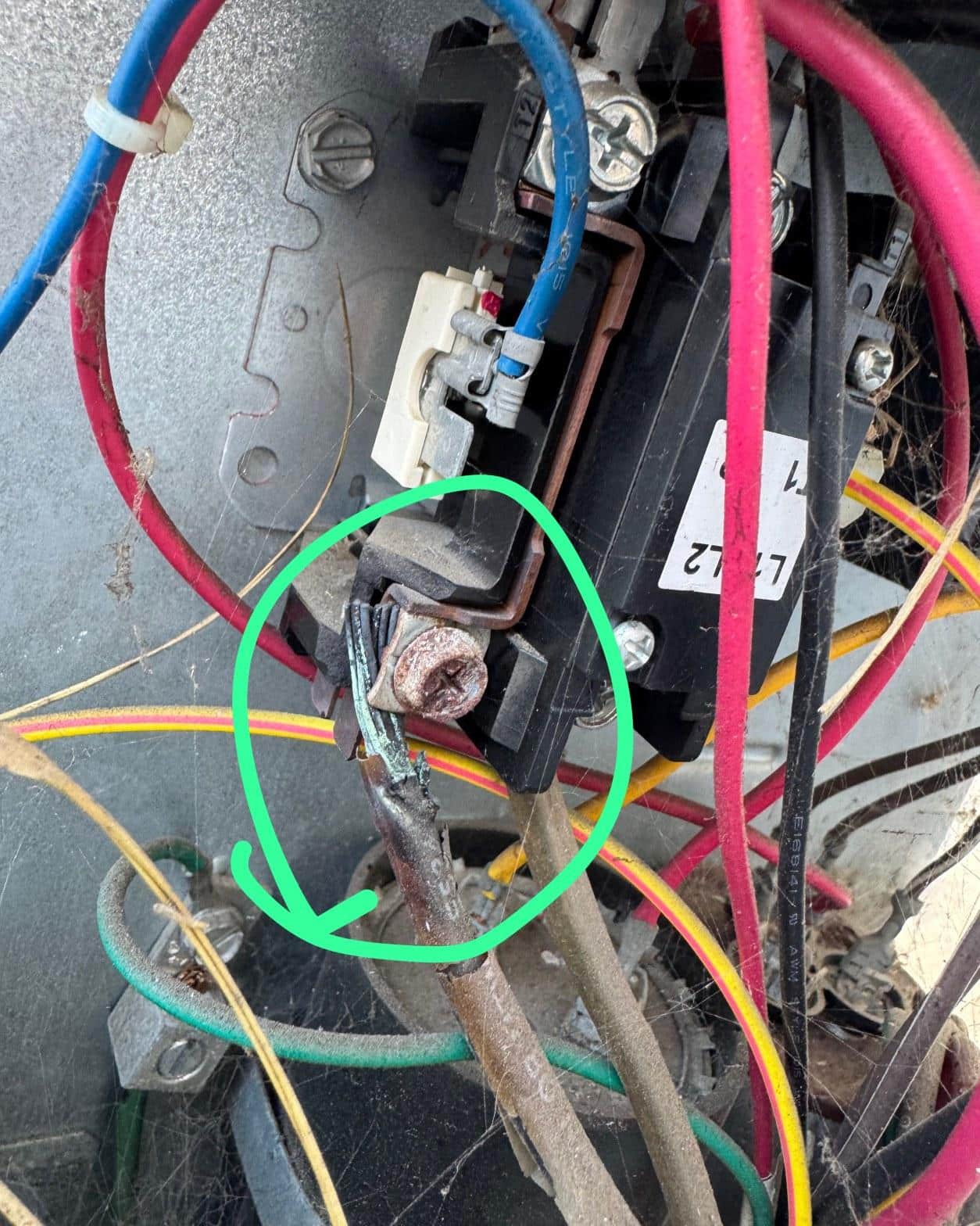
Burned power wiring at a contactor terminal is not a cosmetic problem. It is a fire and equipment hazard that needs to be corrected before the system is returned to service. The gallery photos on this job show the damage clearly: the insulation on the 240V supply conductors had charred and receded, exposing bare copper at the lug where the wire connects to the contactor’s line-side terminal. The terminal itself showed heavy oxidation and pitting consistent with sustained arcing.
This kind of damage typically starts with a loose terminal screw. A connection that carries 20 to 40 amps of load but is not torqued down properly develops resistance at the contact point. Resistance produces heat, heat burns the insulation, and the cycle accelerates until the connection fails completely or causes a fault. By the time visible charring appears, the conductor has usually been running hot for an extended period.
Correcting this required removing the damaged wire section entirely, re-terminating with fresh conductors, and torquing the contactor lugs to specification. The contactor itself, a C140A-rated 40-amp unit visible in the photos, was intact and did not require replacement on this visit.
The Furnace Capacitor
The furnace also had a degraded capacitor that needed replacement as part of this same service call. Furnace capacitors support the indoor blower motor. A weakened capacitor causes the blower to draw higher amperage on startup, which shortens motor life and can trip the system’s internal protection. Replacing it while already on site costs a fraction of a separate return visit.
As of 2026, California homeowners who upgrade to qualifying high-efficiency HVAC equipment may be eligible for the Inflation Reduction Act federal tax credit of up to $600 for central air conditioners meeting ENERGY STAR efficiency thresholds. Capacitor replacement alone does not qualify, but it is worth asking about credits when a full system upgrade is being considered.
ServiStar is Licensed by the California Contractors State License Board (CSLB), which requires that all electrical work on HVAC systems meet California’s adopted mechanical and electrical codes.
Schedule Your AC Repair Before the Next Heat Wave
If your condenser is short-cycling, your fan is sluggish to start, or you notice scorch marks anywhere inside the electrical compartment, those are symptoms that need a technician on site today, not next week. Call ServiStar to book a diagnostic visit. We carry common capacitor sizes on the truck, so most repairs are completed in a single trip without a parts delay.
Gallery
Frequently Asked Questions
How do I know if my AC capacitor has gone bad?
The most common signs are a condenser fan that spins slowly or won't start at all, a compressor that hums but doesn't run, or an air conditioner that short-cycles and trips its breaker. A technician can confirm a failed capacitor in minutes with a capacitance meter reading.
Is it safe to run my air conditioner if the wiring looks burned inside the unit?
No. Burned wiring at a contactor terminal indicates sustained arcing or overheating, which is a fire and equipment hazard. The system should be shut off at the disconnect and the breaker until a technician can inspect and re-terminate the damaged conductors.
How much does it usually cost to replace a run capacitor on a central AC unit?
Dual run capacitor replacement on a residential condenser typically runs between $150 and $350 all-in, depending on the MFD rating, voltage rating, and the service call fee in your area. The part itself is usually $20 to $60; the rest is labor and the diagnostic visit.
Why would I need to replace the capacitor on my furnace at the same time as the one on my AC condenser?
The furnace capacitor supports the indoor blower motor, while the condenser capacitor supports the compressor and outdoor fan motor. They are separate parts on separate pieces of equipment. If both are aging or showing degraded readings on the same service call, replacing them together saves a second trip charge and prevents a follow-up failure weeks later.
How long does a run capacitor typically last in a hot climate like Southern California?
Most run capacitors last 8 to 12 years under normal conditions, but high ambient temperatures accelerate degradation. In areas where summer temperatures regularly exceed 95°F, it is common to see capacitor failures on units as young as 7 to 8 years old, especially if the unit sits in direct afternoon sun.
What causes the wiring inside an AC contactor to burn?
The most common cause is a loose terminal screw on the contactor lug. When a connection carrying 20 to 40 amps of current is not tight, resistance builds up at the contact point, generating heat that chars the wire insulation and pits the terminal. Correcting it requires removing the damaged wire section and re-terminating with fresh conductors, not just tightening the screw.