Do You Need a Permit to Install a Tankless Water Heater in California?
Installing a tankless water heater in California almost always requires a permit, and skipping that step can cost you far more than the permit itself. This guide walks you through every compliance requirement you need to know.

Yes, you almost always need a permit to install a tankless water heater in California. This applies whether you are replacing an old tank-style unit or doing a brand-new installation. This permit to install tankless water heater california guide covers exactly which permits are required, what inspectors check, how the process works, and what is at stake if you skip it.
Why Does California Require a Permit for Tankless Water Heater Installation?
California requires permits because a tankless water heater installation involves gas lines, electrical wiring, venting, and seismic anchoring, all of which carry real safety risks if done incorrectly. A permit puts a licensed inspector between your home and a potential hazard.
Tankless units, also called demand water heaters, heat water only when you turn on a tap. They draw significantly more gas or electricity in short bursts than a traditional tank. A gas-fired tankless unit can require a gas line upgrade to handle flows of 150,000 to 200,000 BTUs per hour, which is two to three times what a standard 40-gallon tank heater uses. That kind of gas demand requires a proper inspection.
A gas-fired tankless unit can require a gas line upgrade to handle flows of 150,000 to 200,000 BTUs per hour, which is two to three times what a standard 40-gallon tank heater uses.
California also enforces California’s Title 24 building energy standards, which set minimum efficiency levels for water heaters sold and installed in the state. A permit inspection confirms the unit you installed actually meets those standards.

What Permits Do You Actually Need for a Tankless Water Heater in California?
Most tankless water heater installations in California require at least two permits: a plumbing permit and either a gas permit or an electrical permit, depending on fuel type. Some jurisdictions bundle these into a single mechanical or building permit, but the inspections are separate.
Here is a breakdown of the permits that typically apply:
- Plumbing permit: Required in virtually every California city and county. Covers the water supply connections, pressure relief valve, and condensate drain (on condensing models).
- Gas permit: Required for natural gas or propane tankless units. Inspectors verify pipe sizing, shutoff valves, and pressure. This is separate from the plumbing permit in most jurisdictions.
- Electrical permit: Required for electric tankless water heaters and for gas units that need a dedicated 120V circuit for the control board. Many high-output electric tankless units require a 240V circuit rated at 100 amps or more.
- Mechanical permit: Required when the venting system changes. Tankless units use direct-vent or power-vent systems that exhaust horizontally through an exterior wall, which is a different configuration than a traditional flue.
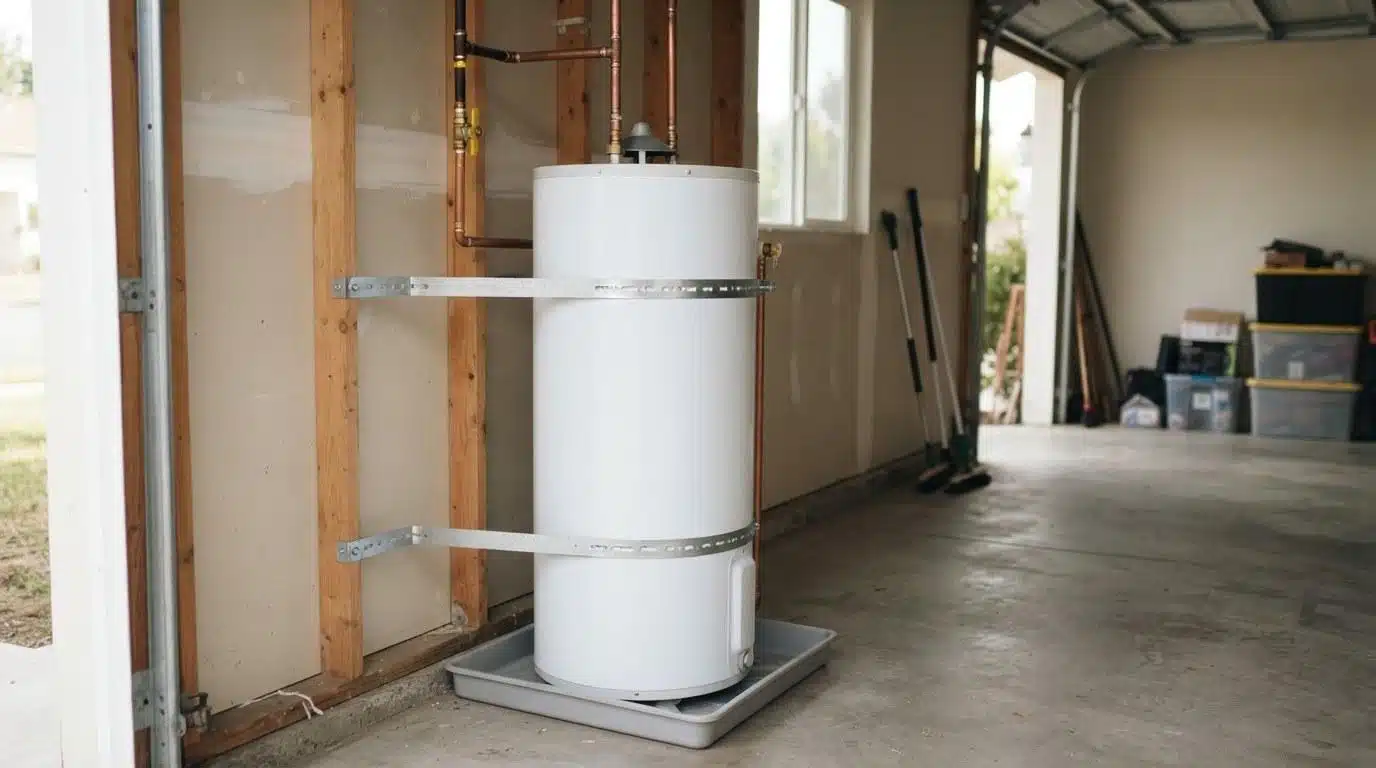
- Seismic strapping inspection: California law requires water heaters to be strapped to resist earthquake movement. Inspectors confirm this even on wall-mounted tankless units.
If your installation changes the location of the unit, adds a recirculation pump, or requires a new gas meter, additional permits or utility coordination may apply. Always confirm with your local building department before work begins.
| Fuel Type | Permits Typically Required | Key Inspection Points |
|---|---|---|
| Natural gas | Plumbing, gas, mechanical (venting) | Gas line sizing, shutoff valve, vent termination, seismic strap |
| Propane | Plumbing, gas, mechanical (venting) | Tank distance, regulator, vent clearance, seismic strap |
| Electric | Plumbing, electrical | Panel capacity, dedicated circuit, wire gauge, GFCI protection |
How Does the Permit Process Work, Step by Step?
The permit process for a tankless water heater in California typically takes 1 to 5 business days for approval, with the inspection scheduled after installation is complete. Many jurisdictions now accept online applications, which speeds things up considerably.
- Choose a licensed contractor. In California, only contractors licensed by the California Contractors State License Board (CSLB) can legally pull permits for plumbing, gas, or electrical work. A C-36 license covers plumbing, and a C-20 covers HVAC and mechanical work. Verify any contractor’s license at the CSLB website before signing anything.
- Submit the permit application. Your contractor submits the application to your local building department. The application describes the unit model, BTU or wattage output, venting type, and any gas or electrical changes.
- Receive permit approval. Most routine replacements are approved over the counter or within one to three business days. More complex installations involving gas line upgrades or panel work may take up to five business days.
- Complete the installation. Work must match what was described in the permit application. The permit card must be posted at the job site.
- Schedule the inspection. Your contractor or you request an inspection through the building department. An inspector visits to verify the installation meets the California Plumbing Code, California Mechanical Code, and Title 24 requirements.
- Receive sign-off. If everything passes, the inspector signs off and the permit is closed. Keep a copy of the final inspection record with your home documents.
On our service calls for tankless water heater replacements, we find that the venting termination location is the most common point inspectors flag, especially when the new unit vents horizontally through a wall that was not used for exhaust before. Confirming the termination clearances before the unit goes on the wall saves a return trip.

What Code Requirements Apply to Tankless Water Heaters in California?
California tankless water heater installations must comply with the California Plumbing Code, the California Mechanical Code, California’s Title 24 building energy standards, and local amendments adopted by your city or county. The unit itself must also meet ENERGY STAR efficiency ratings to qualify for available rebates, though ENERGY STAR certification is not always a permit requirement.
Key code requirements include:
- Minimum efficiency: California’s Title 24 sets a Uniform Energy Factor (UEF) floor for residential water heaters. As of the 2022 Title 24 update, most residential gas tankless units must meet a UEF of 0.82 or higher. Many high-efficiency condensing models exceed 0.95 UEF.
- Seismic strapping: California Health and Safety Code Section 19211 requires all water heaters to be braced, anchored, or strapped to resist seismic forces. Wall-mounted tankless units must be secured to structural framing, not just drywall.
- Pressure relief valve: A temperature and pressure (T&P) relief valve is required. The discharge pipe must terminate within 6 inches of the floor or drain to an approved location.
- Venting clearances: Direct-vent and power-vent terminations must maintain specific clearances from windows, doors, gas meters, and electrical panels, typically a minimum of 12 inches from any opening and 4 feet below any window that opens.
- Gas line sizing: The supply line must be sized to deliver adequate pressure at full demand. Undersized lines cause nuisance shutdowns and are a code violation.
- Condensate management: Condensing tankless units produce acidic condensate. The drain must connect to an approved drain or go through a neutralizer before reaching the sewer, per local plumbing codes.
- Carbon monoxide detector: California law requires a CO detector in any room containing a gas appliance. If one is not already present, the inspector may require installation before sign-off.
Local jurisdictions can adopt amendments that are stricter than the state code. Los Angeles County, for example, has additional requirements around gas appliance installation in certain fire hazard severity zones. Always check with your local building department for any local amendments.
How Much Does It Cost to Pull a Permit for a Tankless Water Heater?
Permit fees for a tankless water heater installation in California typically range from $75 to $400, depending on the jurisdiction and the scope of work. Cities with higher administrative costs or complex plan-check requirements tend to sit at the higher end of that range.
Permit fees for a tankless water heater installation in California typically range from $75 to $400, depending on the jurisdiction and the scope of work.
Several factors affect where your permit cost lands:
- Number of permits required: A gas line upgrade adds a separate gas permit fee on top of the plumbing permit.
- Electrical work: Panel upgrades or new dedicated circuits add an electrical permit fee, which can run $100 to $250 on its own.
- Plan check fees: Some jurisdictions require a plan check for new installations (not just replacements), which adds a flat fee or a percentage of the project value.
- Contractor vs. owner-builder: Homeowners can pull owner-builder permits in California, but doing so means you take on full legal liability for the work. Most plumbing and gas work requires a licensed contractor regardless.
Permit fees are a small fraction of the total project cost. In the California regional market, a complete tankless water heater installation, including the unit, labor, permits, and any gas or electrical upgrades, typically ranges from $1,500 to $4,500 depending on the unit’s output, fuel type, and the complexity of the venting and gas line work. For a custom quote on your specific situation, contact ServiStar at (818) 873-0613.
If you choose an ENERGY STAR-certified unit, you may qualify for rebates through the TECH Clean California program or your local utility, which can offset $100 to $500 of the project cost. The Inflation Reduction Act federal tax credit also provides a credit of up to 30% of the cost of qualifying heat pump water heaters, which is a category that now includes certain hybrid and heat-pump tankless models.

What Happens If You Skip the Permit?
Installing a tankless water heater without a permit in California can result in fines, a required tear-out and reinstallation, a failed home sale, and voided homeowner’s insurance coverage on any water or fire damage linked to the unpermitted work. The risks are not theoretical; they come up regularly during real estate transactions.
Here is what unpermitted work can cost you:
- Municipal fines: Most California cities charge double or triple the original permit fee as a penalty for after-the-fact permit applications. Some jurisdictions issue separate code enforcement fines on top of that.
- Forced removal: If an inspector determines the work does not meet code, they can require the installation to be removed and redone. That means paying for labor twice.
- Home sale complications: Buyers’ home inspectors and lenders routinely flag unpermitted work. You may be required to pull an after-the-fact permit, bring the installation up to current code, or reduce the sale price to account for the liability.
- Insurance denial: If a gas leak or water damage is traced to an unpermitted appliance, your homeowner’s insurance carrier has grounds to deny the claim. A denied claim on a major loss can far exceed the cost of the original permit.
- Safety risk: Improperly vented gas appliances produce carbon monoxide. An uninspected installation has no third-party verification that the venting is correct.
Some contractors offer to skip the permit to save time or money. That is a red flag. A contractor licensed by the California Contractors State License Board (CSLB) is required by law to pull permits for work that requires them. Any contractor who suggests skipping permits is putting their license and your safety at risk.
Ready to Get Your Tankless Water Heater Installed the Right Way?
Permits protect your home, your insurance, and your investment in a high-efficiency demand water heater. The process is straightforward when you work with a licensed contractor who handles the paperwork from start to finish.
ServiStar handles tankless water heater installations across Southern California, including all required permits, inspections, and code compliance. Whether you need a new gas tankless unit, an electric tankless water heater, or an upgrade to support a whole-home demand system, the team is ready to help.
Call (818) 873-0613 to schedule a site assessment and get a written quote that includes permit fees, labor, and equipment. Get the job done right the first time so it passes inspection and stays covered.
Frequently Asked Questions
Do I always need a permit to replace a water heater with a tankless unit in California?
Yes, in nearly every California jurisdiction a permit is required when replacing a traditional tank water heater with a tankless unit. The change in venting, gas line demand, and appliance type triggers permit requirements under the California Plumbing Code and California Mechanical Code. A simple like-for-like tank replacement sometimes qualifies for a simplified permit, but switching to a tankless model almost never does.
How do I know what size tankless water heater I need for my home?
Sizing a tankless water heater depends on your peak hot water demand, measured in gallons per minute, and the temperature rise required in your climate. A typical California household with two bathrooms needs a unit rated for 6 to 8 gallons per minute. A licensed plumber can calculate your exact load based on the number of fixtures and your incoming cold water temperature, which in Southern California typically ranges from 60 to 70 degrees Fahrenheit in winter.
Can I install a tankless water heater myself and pull my own permit in California?
California allows homeowners to pull owner-builder permits for work on their own residence, but gas and plumbing work legally requires a licensed contractor in most jurisdictions. Even if you pull the permit yourself, the work must pass inspection. An improperly vented or undersized gas line is a safety hazard, and any damage linked to DIY gas work can void your homeowner's insurance.
How long does a tankless water heater permit inspection take in California?
The inspection itself typically takes 20 to 45 minutes once the inspector arrives. Scheduling the appointment is usually the longer part of the process, with wait times ranging from one to five business days depending on your local building department's workload. Your contractor can request the inspection on your behalf after the installation is complete.
Are there rebates available for installing a tankless water heater in California?
Yes, rebates are available through the TECH Clean California program and many local utilities for qualifying high-efficiency tankless water heaters. The Inflation Reduction Act federal tax credit also covers up to 30% of the cost of qualifying heat pump water heaters, which includes certain hybrid and heat-pump tankless models. Ask your contractor to confirm which rebates apply to the specific unit being installed before you purchase.