California Water Heater Replacement Regulations: Permits, Codes and What Homeowners Must Know
Replacing a water heater in California requires a permit in almost every jurisdiction, and skipping that step can cost you far more than the permit itself. This guide breaks down exactly what the state requires, what inspectors check, and how to stay compliant.

Do You Really Need a Permit to Replace a Water Heater in California?
Yes, a permit is required for water heater replacement in virtually every California jurisdiction. This applies whether you are swapping a gas tank, an electric tank, or upgrading to a tankless or heat-pump water heater. The California Plumbing Code and the California Mechanical Code establish the statewide baseline, and local building departments enforce those rules through the permit and inspection system.
Some homeowners assume a simple “like-for-like” swap does not need a permit. That assumption is almost always wrong in California. Even replacing a 40-gallon gas water heater with an identical 40-gallon gas model triggers permit requirements because the installation involves gas lines, venting, seismic bracing, and pressure-relief connections that must be inspected for public safety.
The only common exception is a repair that does not touch the gas line, venting, or water connections, such as replacing a thermostat or a heating element on an existing electric unit. Full replacement of the appliance itself is not a repair, and it requires a permit.

What California Water Heater Replacement Permit Requirements Actually Cover
California water heater replacement permit requirements address six core areas: seismic strapping, temperature and pressure relief (T&P) valves, venting and combustion air, gas supply connections, pan and drain provisions, and clearances around the unit. Each area has specific code minimums that an inspector will verify before signing off on the job.
Seismic Strapping
California sits in one of the most seismically active regions in the world. California’s Office of Emergency Services and the California Plumbing Code both require water heaters to be strapped to the wall with approved metal strapping at two points: the upper third and the lower third of the tank. Unstrapped tanks can topple in an earthquake, rupturing gas lines and causing fires or flooding.
T&P Relief Valve and Discharge Pipe
Every water heater must have a listed temperature and pressure relief valve. The discharge pipe from that valve must run to within 6 inches of the floor, to a floor drain, or to the exterior, and it must be the same diameter as the valve outlet. It cannot be capped, plugged, or reduced in size.
Venting and Combustion Air
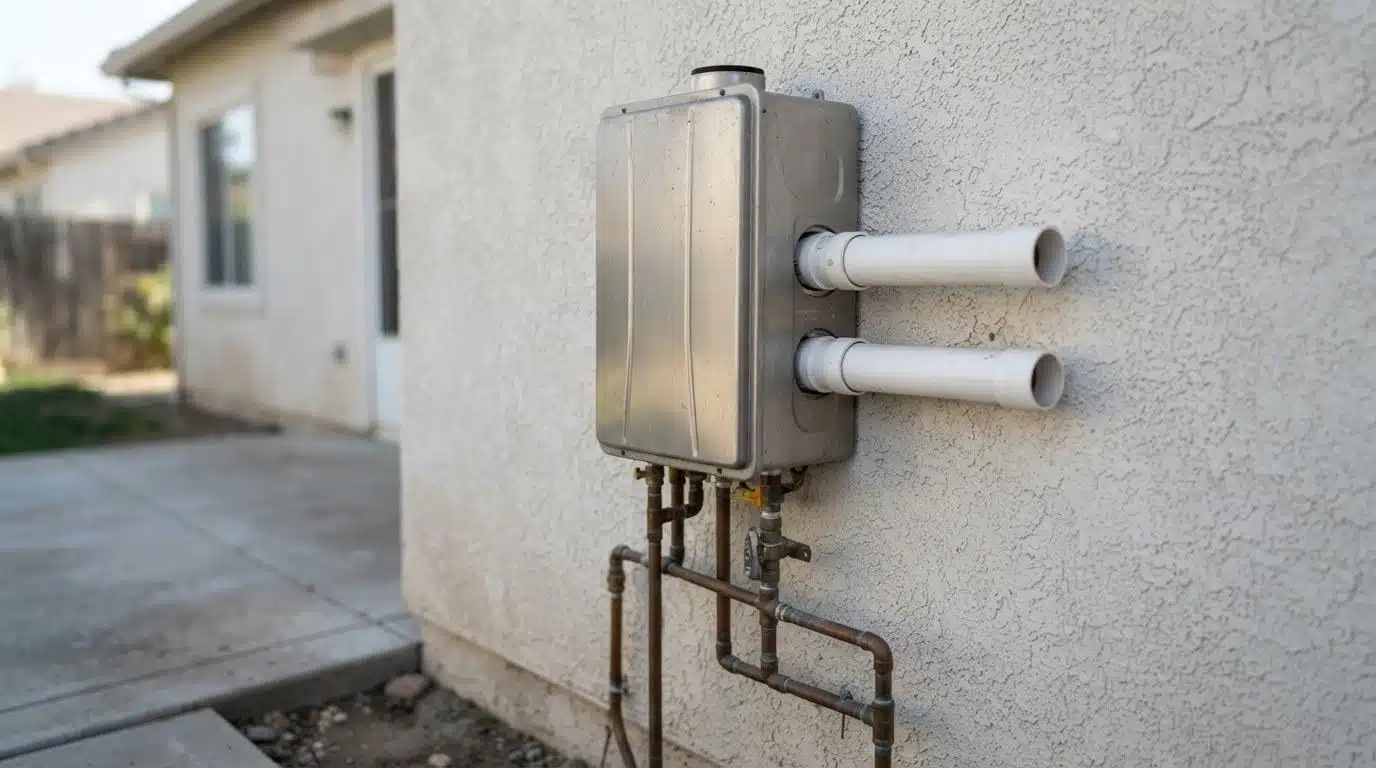
Gas and propane water heaters produce combustion byproducts that must be safely vented to the outside. The California Mechanical Code specifies vent pipe material, diameter, slope, and clearance from combustibles. Tankless units with sealed, direct-vent systems have different requirements than atmospherically vented tank units. Inspectors check that the vent terminates correctly and that the appliance has adequate combustion air supply.
Gas Supply and Shut-Off
The gas supply line must be properly sized for the BTU load of the new appliance, and an accessible shut-off valve must be installed within 3 feet of the unit. If you are upgrading from a standard tank to a high-efficiency tankless water heater, the BTU demand can increase significantly, which may require a larger gas line and a different meter size.
Drip Pan and Condensate Drain
Water heaters installed indoors, in attics, or above living spaces must have a drip pan with a drain line routed to an approved location. Heat-pump water heaters produce condensate and also require a condensate drain.
Clearances
The unit must have the minimum clearances specified by the manufacturer and by code on all sides for service access and fire safety. Garage installations require the ignition source to be at least 18 inches above the floor to prevent accidental ignition of gasoline vapors.
How Does the Permit and Inspection Process Work?
The permit process for a water heater replacement typically takes between one and five business days for permit issuance, followed by a single on-site inspection after the installation is complete. Here is what the process looks like from start to finish.
- Apply for the permit. The licensed plumber or homeowner-owner-builder submits a permit application to the local building department. Many California cities now accept online applications. You will need the address, the type and BTU or wattage of the new unit, and the contractor’s license number if a contractor is pulling the permit.
- Pay the permit fee. Permit fees vary by jurisdiction. In most California cities, a water heater permit fee ranges from roughly $50 to $250 depending on the scope of work and the local fee schedule.
- Complete the installation. The licensed plumber installs the new water heater, making all required connections and installing the required seismic straps, T&P discharge pipe, and drip pan.
- Schedule the inspection. The permit holder calls or goes online to schedule the final inspection. Most jurisdictions can schedule within one to three business days.
- Pass the inspection. The building inspector checks all code requirements. If everything passes, the permit is finaled and the job is done. If corrections are needed, the inspector will note them and a re-inspection is scheduled.
- Keep your records. Store the finaled permit with your home records. You will need it when you sell the property.

Homeowners who act as their own general contractor (owner-builder) can pull the permit themselves in California, but most lenders and real estate agents recommend using a licensed contractor. A Licensed by the California Contractors State License Board (CSLB) plumber carries the liability if something goes wrong during installation, and their license number is on record with the permit.
Which Codes and Standards Apply to Water Heater Installations?
California water heater installations are governed by the California Plumbing Code (Title 24, Part 5), the California Mechanical Code (Title 24, Part 4), and the California Energy Code (Title 24, Part 6). Local jurisdictions adopt these codes and may amend them with stricter local requirements.
| Code or Standard | What It Governs | Where to Find It |
|---|---|---|
| California Plumbing Code (Title 24, Part 5) | Water connections, T&P valves, drip pans, seismic strapping | California Building Standards Commission |
| California Mechanical Code (Title 24, Part 4) | Venting, combustion air, gas appliance installation | California Building Standards Commission |
| California Energy Code (Title 24, Part 6) | Minimum efficiency ratings for new water heaters | California Energy Commission |
| ENERGY STAR Efficiency Ratings | Voluntary efficiency benchmark; required for some rebate programs | energystar.gov |
| Local Municipal Amendments | Additional local requirements beyond state minimums | Your local building department |
California’s Title 24 building energy standards set minimum efficiency levels for new water heaters sold and installed in the state. As of the 2022 code cycle, new gas storage water heaters must meet a Uniform Energy Factor (UEF) of at least 0.64 for a 50-gallon unit. Heat-pump water heaters must meet a UEF of at least 2.0. These minimums are enforced at the permit stage, so an inspector will check that the unit you installed meets the current standard.
For homeowners upgrading to a heat-pump water heater or a high-efficiency gas tankless unit, the Inflation Reduction Act federal tax credit offers up to $600 for qualifying water heaters, and California’s TECH Clean California and SoCalREN programs offer additional rebates. These programs typically require the unit to be ENERGY STAR certified and the installation to be permitted and inspected.
On our service calls for water heater replacement, we frequently find that the existing unit was installed without a permit years earlier, which means the seismic strapping, T&P discharge pipe, and gas shut-off are often not up to current code. Catching those issues at replacement time is far less expensive than discovering them during a home sale inspection.
How Much Does a Permitted Water Heater Replacement Cost in California?
In the Southern California market, a complete permitted water heater replacement typically ranges from $900 to $2,500 for a standard gas or electric tank unit, and from $1,800 to $5,000 or more for a tankless or heat-pump water heater. The permit fee itself is usually a small fraction of the total project cost.
Several factors move the price within those ranges:
- Unit type and capacity: A 40-gallon gas tank costs less than a 75-gallon unit or a high-efficiency heat-pump water heater.
- Fuel source conversion: Switching from gas to electric (or vice versa) adds electrical or gas-line work that increases labor and material costs.
- Venting upgrades: Older homes often have undersized or deteriorated vent pipes that must be replaced to meet current code.
- Location of the unit: Attic or crawl-space installations take more labor than a garage or utility-room swap.
- Permit and inspection fees: These range from roughly $50 to $250 depending on the jurisdiction.
- Code corrections on existing conditions: If the prior installation lacked seismic strapping, a proper T&P discharge pipe, or a code-compliant drip pan, those corrections are added to the scope.
Always request a written, itemized quote before any work begins. A reputable contractor will include the permit fee in the quote and will pull the permit before starting work, not after. Contact ServiStar at (818) 873-0613 for a custom quote on your specific situation.

What Are the Most Common Code Violations Inspectors Catch?
The most common water heater code violations in California involve missing or improperly installed seismic straps, incorrect T&P discharge pipe routing, inadequate venting, and garage installations where the ignition source is below the required 18-inch height. These are not minor paperwork issues; each one represents a real safety risk.
- Missing seismic straps: Both upper and lower straps must be present and anchored to wall studs or blocking, not just drywall.
- Capped or reduced T&P discharge pipe: The discharge pipe must be full-size and terminate where a person will not be scalded if the valve opens.
- Improper vent slope or material: Vent connectors must slope upward toward the flue at a minimum of one-quarter inch per foot and must be the correct material for the flue temperature.
- No drip pan or improper drain routing: Indoor installations need a pan with a drain that goes somewhere safe, not just to the attic floor or a wall cavity.
- Garage ignition height: The burner or ignition source must be at least 18 inches above the garage floor. Many older units sit directly on the slab.
- Undersized gas line: Upgrading to a tankless unit with a higher BTU demand without resizing the gas supply line causes pressure drop and performance problems.
- No accessible gas shut-off: A dedicated shut-off within 3 feet of the appliance is required and must be operable without tools.
Unpermitted water heater installations are a common discovery during real estate transactions in Southern California. When a home inspector or buyer’s agent flags an unpermitted water heater, the seller typically must either pull a retroactive permit (which requires bringing the installation up to current code) or negotiate a price reduction. Either path is more expensive than doing it right the first time.
Unpermitted water heater installations are a common discovery during real estate transactions in Southern California, and bringing them up to current code after the fact is more expensive than doing it right the first time.
Ready to Replace Your Water Heater the Right Way?
A properly permitted water heater replacement protects your home, your insurance coverage, and your investment. California’s code requirements exist because water heaters are connected to gas lines, venting systems, and pressurized water, and failures in any of those systems can cause serious harm.
ServiStar serves homeowners across Southern California with permitted, code-compliant water heater replacement and repair. Whether you need a standard tank replacement, an emergency water heater repair, or an upgrade to a high-efficiency heat-pump or tankless unit, the team at ServiStar handles the permit, the installation, and the inspection coordination so you do not have to.
Call (818) 873-0613 to schedule your service or request a written quote. Get the job done right the first time, with a finaled permit you can keep for your records.
Frequently Asked Questions
How long does a water heater usually last before it needs replacing?
Most traditional tank water heaters last between 8 and 12 years. Tankless water heaters typically last 15 to 20 years with proper maintenance. If your unit is approaching or past that range and you are seeing rust-colored water, rumbling sounds, or inconsistent hot water, replacement is likely more cost-effective than repair.
Can I replace my own water heater in California without hiring a plumber?
California law allows homeowners to pull an owner-builder permit and install their own water heater on property they own and occupy. However, the installation still must meet all code requirements and pass a final inspection. Most homeowners find that hiring a licensed plumber reduces the risk of a failed inspection and ensures the gas and venting connections are made safely.
What happens if I replace my water heater without a permit in California?
Installing a water heater without a permit can void your homeowner's insurance coverage for any water or fire damage related to the appliance. It can also create a title problem when you sell your home, requiring you to either pull a retroactive permit and bring the installation up to current code or renegotiate the sale price. Local building departments can also issue fines for unpermitted work.
How much does a water heater permit cost in California?
Permit fees vary by city and county, but most California jurisdictions charge between $50 and $250 for a standard water heater replacement permit. Some cities with higher fee schedules may charge more, particularly if the scope includes gas line work or electrical upgrades. Your licensed plumber or local building department can give you the exact fee for your address.
Are there rebates available for replacing my water heater with a more efficient model in California?
Yes. California homeowners who upgrade to a qualifying heat-pump water heater may be eligible for the Inflation Reduction Act federal tax credit of up to $600, plus additional rebates through programs like TECH Clean California and SoCalREN. The unit typically must be ENERGY STAR certified and the installation must be permitted and inspected to qualify. Check with your utility company for current program availability.